The end of his earthly life
The garden, the cross, the tomb
A last meal. A prayer he did not want to pray. A Roman execution under Pontius Pilate. Then the claim the Gospels will not give up: the tomb did not keep him.
The meal and the garden
The life
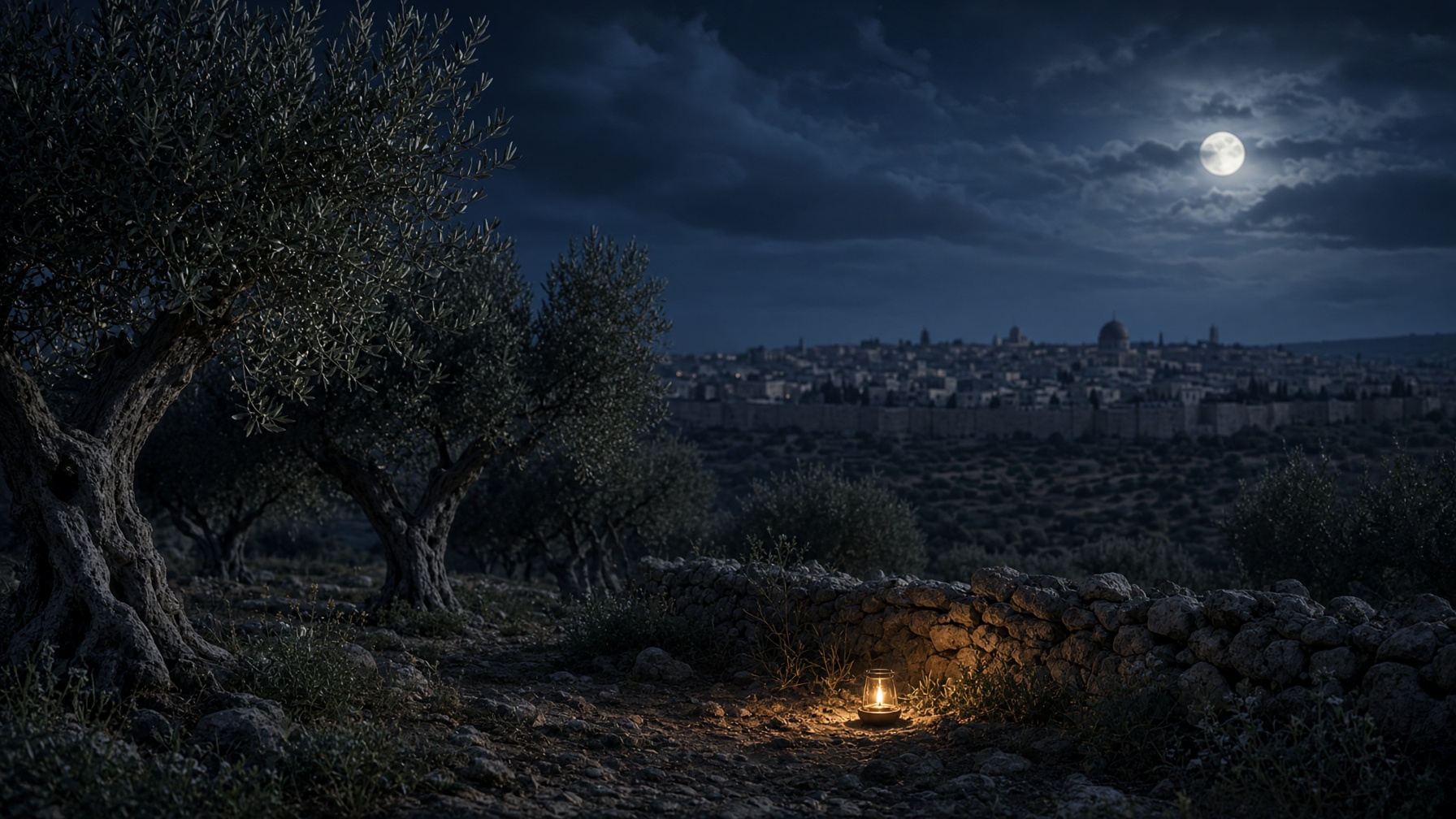
The last night is a table, then a garden. He takes bread, gives thanks, and tells them to remember him. A few hours later he is on his face among the olives, asking that the cup pass, and then giving the will back.
This is as human as the record gets. Dread is not denied. Obedience is not the absence of it. The King James also keeps the line about sweat like great drops of blood. That line is absent from some of the oldest Greek copies, and present in the copies behind the King James. The prayer of the cup is not in doubt.
King James Version
And he took bread, and gave thanks, and brake it, and gave unto them, saying, This is my body which is given for you: this do in remembrance of me.
King James Version
Saying, Father, if thou be willing, remove this cup from me: nevertheless not my will, but thine, be done.
King James Version
And being in an agony he prayed more earnestly: and his sweat was as it were great drops of blood falling down to the ground.
In the King James, and in most later Greek copies. Some of the oldest copies do not have this verse. Verse 42 stands either way.
A lesson
Obedience can tell the truth about fear
He does not perform calm. He asks for another way, and he stays. Anyone who has had to do a right thing while wanting to be anywhere else already knows the shape of this prayer.
Under Pilate
The life
Before the governor he speaks of truth, and of why he was born. Pilate’s reply is three words, and then a verdict the narrative says was not a finding of guilt. The execution happens anyway. Crucifixion was how Rome killed a man in public and meant the shame to last.
From the cross the KJV records a prayer for the people driving the nails, and a last word: It is finished. He bows his head and gives up the ghost. The page will not linger on the method. The death is the fact.
King James Version
Pilate therefore said unto him, Art thou a king then? Jesus answered, Thou sayest that I am a king. To this end was I born, and for this cause came I into the world, that I should bear witness unto the truth. Every one that is of the truth heareth my voice. Pilate saith unto him, What is truth? And when he had said this, he went out again unto the Jews, and saith unto them, I find in him no fault at all.
King James Version
And when they were come to the place, which is called Calvary, there they crucified him, and the malefactors, one on the right hand, and the other on the left. Then said Jesus, Father, forgive them; for they know not what they do. And they parted his raiment, and cast lots.
The King James includes “Father, forgive them.” Some early copies omit that sentence and keep the parting of the raiment.
King James Version
When Jesus therefore had received the vinegar, he said, It is finished: and he bowed his head, and gave up the ghost.
King James Version
But he was wounded for our transgressions, he was bruised for our iniquities: the chastisement of our peace was upon him; and with his stripes we are healed.
A prophet, read by the church with this day. Luke 24 says that beginning at Moses and the prophets he opened the things concerning himself. This is that reading, not a Roman dispatch.
Outside the Gospels
Cornelius Tacitus, a Roman historian writing around AD 116, had no love for Christians. Recording Nero’s cruelty after the fire of Rome, he says the name came from Christus, who was executed in the reign of Tiberius by the procurator Pontius Pilate. He is explaining a movement he despises. He still places the execution where the Gospels place it.
A lesson
Forgiveness is spoken from the cross
The prayer is not for friends. It is for the people carrying out the killing, and it is spoken while it is happening. The lesson is as hard as the verse: mercy, in this record, is not saved for a safer hour.
The third day
The life
Women come to the tomb and are told he is not there. Later Thomas will not take the others’ word. The risen Jesus, in John’s account, does not scold the doubt away from a distance. He offers the wounds, and Thomas answers with the highest name in the book.
On the road to Emmaus he is simply a walker who opens the Scriptures. The resurrection scenes keep hands, food, roads, and recognition. They are written as meetings, not as a mood.
King James Version
And the angel answered and said unto the women, Fear not ye: for I know that ye seek Jesus, which was crucified. He is not here: for he is risen, as he said. Come, see the place where the Lord lay.
King James Version
Then saith he to Thomas, Reach hither thy finger, and behold my hands; and reach hither thy hand, and thrust it into my side: and be not faithless, but believing. And Thomas answered and said unto him, My Lord and my God.
King James Version
And beginning at Moses and all the prophets, he expounded unto them in all the scriptures the things concerning himself.
What the text concludes
The divine claim of this chapter is not that he died bravely. Rome had seen brave deaths. The claim is that the crucified man is risen, and that Thomas’s sentence is the right one: My Lord and my God.
Taken up
The life
Acts says they watched him taken up, and a cloud received him. Two men in white ask why they are still staring. The sentence that follows is the hinge of this whole site. The life does not dissolve into a symbol. This same Jesus, they are told, will come in like manner.
King James Version
And when he had spoken these things, while they beheld, he was taken up; and a cloud received him out of their sight. And while they looked stedfastly toward heaven as he went up, behold, two men stood by them in white apparel; Which also said, Ye men of Galilee, why stand ye gazing up into heaven? this same Jesus, which is taken up from you into heaven, shall so come in like manner as ye have seen him go into heaven.
What the text concludes
The end of the earthly days is the start of the promise. The one who was tired, who wept, who was executed under Pilate, is the one the text says will come again.